
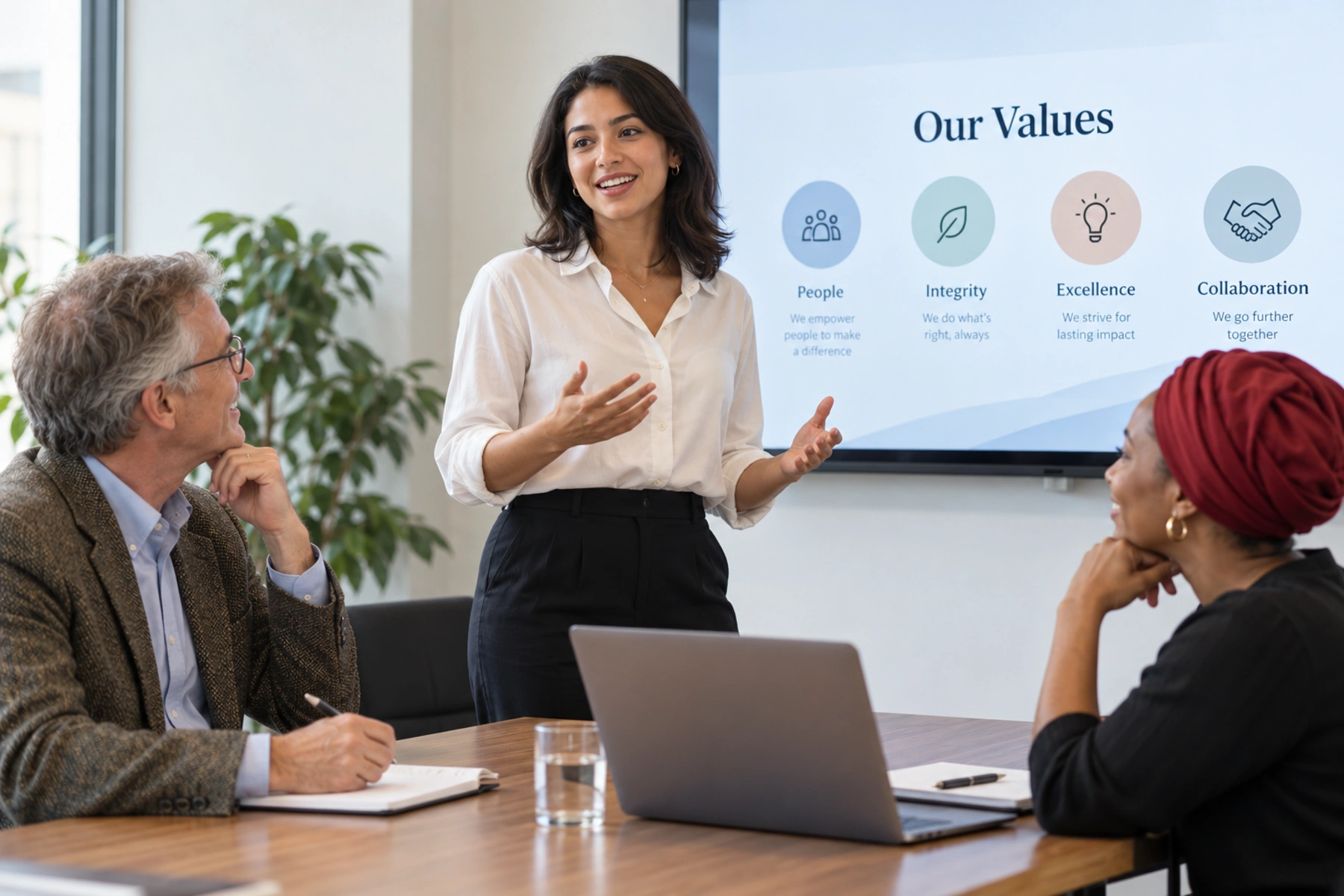
Corporate leadership training
Leadership in Sustainable Business Training Course in Honduras
Give leaders the skills to make sustainability a guiding principle of the business: knowing its footprint, spending less on energy and materials, choosing responsible suppliers, preparing for climate pressures and governing openly, so the organisation stays competitive.
- In-person, virtual
or blended - Customised for
your organisation - Delivered worldwide,
including Honduras - For owners, executives
and entrepreneurs
Course overview
What Is Leadership in Sustainable Business?
Sustainable business leadership is the capacity to steer an organisation towards lasting commercial success while practising environmental stewardship and social responsibility. This course explores the main sustainability frameworks, how to assess an operation’s impact, resource efficiency, responsible sourcing, resilience to a changing climate, greener business models, engagement with stakeholders and sound governance.
Interactive workshops, case studies and real-world simulations let participants chart where a business affects people and the environment, uncover energy and waste savings and rework its model, using organisations similar to those leaders in Honduras manage.
Business owners, executives and entrepreneurs in Honduras learn to treat sustainability as a working principle rather than a slogan: building it into strategic decisions, bringing staff and partners along, and keeping the organisation competitive and resilient over the long term.
Why it matters
Why Sustainable Business Matters in Honduras
Businesses in Honduras face growing pressure to operate in environmentally responsible and socially conscious ways. Leaders who build stewardship and resilience into everyday decisions protect their competitiveness for years to come.
Resources are finite
Water, power and raw materials cost more every year, and an operation that squanders them loses ground to rivals.
The climate is changing
Floods, dry spells and shifting weather test supply chains and sites alike.
Stakeholders are watching
Buyers, partners and neighbours increasingly choose organisations that behave in a socially conscious way.
Shared prosperity
Responsible firms spread the gains of economic growth more widely in Honduras.

The Knowles leadership approach
From Insight to Impact
Participants work through six stages that turn sustainability into practice inside a business, from tracing its footprint to reporting candidly on results, and judge every stage on commercial grounds as well as ethical ones.
Sustainable business in action
- 1. ImpactWhat do we affect?
- 2. PrioritiesWhat matters most?
- 3. InnovateHow can we do it better?
- 4. EngageWho must we work with?
- 5. MeasureAre we improving?
- 6. ReportAre we open about it?
Key benefits
Why Organisations Choose This Course
This programme helps your leaders and your organisation to:
Lower Running Costs
Trim spending on power, water, inputs and disposal.
Reduced Business Risk
See environmental, social and supplier risks coming while they are still cheap to handle.
Stronger Reputation
Win the confidence of buyers, partners and lenders.
Resilient Supply
Keep suppliers who treat people fairly and deliver on time.
New Opportunities
Uncover products and markets that responsible practice makes possible.
Trusted Governance
Integrity, openness and accountability shape every strategic decision, starting at the top.
Have questions about this course?
Our team is happy to help. Send us a message and we will get back to you within one business day.

Course curriculum
A practical and structured learning journey.
Twelve units in three stages take participants from seeing what a business affects, through cleaner and leaner operations, to the strategy, governance and reporting that keep a culture of sustainability alive.
- Unit 1
Triple Bottom Line
- Judge results on people, planet and profit side by side.
- Spot where a quick profit today costs the business value later.
- Present sustainability as a matter of competitiveness.
- Unit 2
Development Goals
- Read the UN Sustainable Development Goals as business opportunities.
- Pick out the goals your operations touch most.
- Tie each sustainability aim to strategic plans.
- Unit 3
Impact Assessment
- Chart how your operations affect nature and communities.
- Follow each impact along the chain, from raw input to end user.
- Collect the evidence that shows which impacts weigh most.
- Unit 4
Material Issues
- Score each issue by its weight for stakeholders and for the business.
- Concentrate resources on the handful of issues that count.
- Turn priorities into targets you can measure.
- Unit 5
Cleaner Energy
- Trace where power is consumed and where it leaks away.
- Weigh renewable choices such as solar panels.
- Build the financial argument for energy upgrades.
- Unit 6
Waste Reduction
- Stop waste at its source before it needs recycling.
- Give materials a second life and sell by-products.
- Rally employees to cut waste in their daily routines.
- Unit 7
Ethical Sourcing
- Define what you expect from suppliers on labour, safety and nature.
- Check supplier practices and risks in a fair, consistent way.
- Source nearby when it builds up local communities.
- Unit 8
Climate Resilience
- Judge how climate shifts and scarce resources hit the business.
- Prepare responses to water, energy and supply shortfalls.
- Design resilience into premises, products and supply.
- Unit 9
Green Ventures
- Look for openings for green products and services.
- Shape business models that earn money from sustainability.
- Pilot new ideas on a small budget before rolling them out.
- Unit 10
Stakeholder Dialogue
- Identify the officials, civic groups and communities with a stake.
- Talk openly with stakeholders and hear their worries.
- Develop answers jointly with partners and neighbours.
- Unit 11
Good Governance
- Spell out the standards of honesty and openness you expect.
- Guard against bribes and conflicts of interest.
- Bring sustainability risks under board scrutiny.
- Unit 12
Honest Reporting
- Follow progress through a few measures that mean something.
- Publish results candidly, shortfalls included.
- Steer clear of inflated green claims that erode trust.
Course agenda
Two-day course agenda.
A sample agenda showing how the two days run, from 9 a.m. to 5 p.m. The final agenda is agreed with you.
Welcome, objectives and introductions
The triple bottom line
Morning break
Development goals
Lunch
Impact assessment
Material issues
Afternoon break
Cleaner energy
Day one reflection
Close
Recap and goals for the day
Waste reduction
Morning break
Ethical sourcing
Lunch
Climate resilience
Green ventures and business models
Afternoon break
Stakeholder dialogue and good governance
Honest reporting and action planning
Close
Participant resources
What participants receive.
A practical set of resources to support learning during the course and application afterwards.
Course Workbook
Content, summaries and activities for every unit.
Templates and Worksheets
Ready-to-use tools to apply learning at work.
Action Plan Template
Turn learning into clear next steps.
Job Aids and Quick Guides
Key models, checklists and frameworks for daily use.
Digital Resources
Additional materials to revisit after the course.
Certificate of Completion
Recognition of the training completed.

Practical application
From theory to real workplace impact.
Participants put the ideas to work on realistic business cases and simulations: tracing impacts, walking a process in search of waste, rebuilding a business model and running a stakeholder meeting, the kinds of choices business leaders in Honduras make.
Impact Mapping
Chart a company’s impacts all the way from suppliers to end customers.
Waste Walk
Walk through an operation stage by stage and list every kind of waste you find.
Model Redesign
Reshape a business model so responsible practice earns its keep.
Stakeholder Forum
Speak for competing interests and settle on a shared next step.
Who should attend
Designed for leaders building responsible businesses.
Suited to anyone who owns, manages or advises a business and wants sustainability at the heart of strategy and day-to-day operations, along with people in government, development agencies and research whose work shapes responsible growth.
- Business OwnersMake responsible practice part of how the firm runs.
- EntrepreneursStart ventures that earn well and do right.
- ExecutivesBring strategy in line with sustainability aims.
- Public OfficialsDesign rules that encourage responsible enterprise.
- Development StaffWork with firms on growth that lasts.
- ResearchersTurn findings into workable answers.
Course format and delivery
Flexible options to suit your organisation.
Choose the format and duration that fit your schedule and learning needs, whether at your workplace in Honduras, online or a mix of both.
In-Person Training
Delivered at your organisation in Honduras or at a suitable venue.
Virtual Training
Interactive, engaging live online delivery.
Blended Learning
A combination of in-person and virtual sessions.
Customised Training
Tailor case studies, organisation focus, delivery mode, modules and duration. Explore Customized Training
- Typical Duration2 Full Days9 a.m. to 5 p.m. Also available as a 1-day, half-day, 90-minute or 60-minute session.
Prerequisites
Prerequisites and experience level.
No prior experience is required. The course suits people new to sustainability and experienced business leaders alike and works well for mixed groups.
No formal prerequisites
Open to anyone who wants to build a more sustainable business.
All experience levels
From students and researchers to senior executives.
Designed for mixed groups
Business, public and development staff learn together.
Ready to take part
Bring a product, site or process you want to improve.

Course framework
A structured approach to developing leaders.
Our framework takes participants round a clear learning cycle: grasp a sustainability idea, test it in a workshop or simulation, reflect on the result and carry it back into their own organisation.
Practical and Actionable
Tools and checks that can be used at work the next day.
Relevant to Honduras
Shaped by the resources, markets and conditions businesses in Honduras work with.
Balanced Thinking
People, planet and profit considered together.
The sustainable business cycle
- 1. LearnCore leadership principles
- 2. ExploreCase studies and discussion
- 3. PractiseRole-plays and simulations
- 4. ReflectSelf-assessment and journaling
- 5. ApplyReal-world projects
- 6. GrowMentoring and peer support
Key learning outcomes
From knowledge to lasting leadership impact.
By the end of this programme, participants will be able to:
- 01
Assess your impact
Pinpoint the biggest environmental and social effects of an operation.
- 02
Set clear priorities
Rank sustainability issues by importance and attach measurable targets to the top ones.
- 03
Use resources well
Cut the energy, water and materials an operation wastes.
- 04
Source responsibly
Agree fair supplier standards and apply them.
- 05
Engage stakeholders
Earn trust through candid dialogue with partners and communities.
- 06
Report honestly
Monitor progress and report it without exaggeration.

Lasting success is measured by what a business leaves behind, not only by what it earns this year.

Example exercises and tools
Learn by doing.
The programme combines hands-on exercises and assessment tools that participants turn on the operations and plans of their own organisation.
In one simulation, participants take charge of a mid-sized business in Honduras that wants to grow without raising its footprint: they decide which impacts to tackle first, agree how to involve staff and suppliers, and present a one-page plan showing how the changes support both the budget and the business’s long-term resilience.
Materiality Matrix
Place each issue on a grid by its importance to stakeholders and to the firm.
Energy Audit
Track down where a site consumes and loses the most energy.
Supplier Checklist
Write the standards each supplier will be assessed against.
Greenwash Test
Test every green claim for evidence and accuracy.
Assessment
Assessment and learning progress.
A mix of steps before, during and after the programme keeps learning relevant and turns it into action.
Before the training
Share your goals and team context.
Agree the objectives and focus areas.
Confirm the format, timing and group.
During the training
Role-plays, simulations and practical exercises.
Feedback from experienced leaders as skills develop.
Group discussion and reflection.
After the training
A personal action plan for the workplace.
Self-assessment and guided journaling to track progress.
Ongoing learning through peers, mentors and the alumni network.
Workplace application
Relevant to your context.
Participants carry the tools into firms and organisations across Honduras, whether that means lowering power use at a single plant or agreeing company-wide sustainability aims.
- Energy ManagementLower power use and bills.
- Waste ProgrammesCut, reuse and recycle more materials.
- Supplier SelectionPick fair, reliable partners.
- Product DesignDesign for efficiency and long life.
- Community ProjectsBuild value alongside local partners.
- Board ReportingKeep the board up to date on progress.

Let’s discuss your requirements
Request a Customised Leadership Programme.
Talk to our team about how this course can be tailored for your organisation in Honduras or other locations worldwide.
- Share your priorities
- Receive a tailored proposal
- Explore delivery options
Adapting for Honduras
Adapting the programme for Honduran organisations.
We tailor the course so it reflects your people, your sector and the context you work in.
Local case studies
Examples and case studies drawn from leaders in Honduras.
Cultural awareness
Content that respects cultural nuances and builds inclusive environments.
Community focus
Projects that address real local and community issues.
Industry and organisation focus
Examples, terminology and scenarios from your sector.

Delivery worldwide
Flexible delivery across Honduras and worldwide.
We deliver this programme in Honduras and in other locations worldwide, with flexible formats and options to suit your organisation.
- In-person
- Virtual
- Blended
At Your Workplace
In-house sessions at your office in Honduras.
A Venue You Choose
Delivered at a training venue that suits your team.
Live Online
Interactive virtual sessions wherever your people are.
Across Countries
Programmes coordinated across several locations worldwide.
Client experiences
What our participants say.
Word-for-word feedback from participants at organisations in Singapore. Read all reviews
Yes, because it helped me learn the basics of critical thinking to generate new ideas, analyze articles, and make arguments.
Yes, the strategic frameworks shared are highly practical and worth learning for career growth.
Yes definitely, since it teaches a fresh, highly constructive approach to problem-solving and team collaboration.
Learning how to translate high-level company strategy into clear, measurable operational targets for our teams.
Yes, particularly for beginners who need a clear, structured way to start organizing workplace information.
Yes, since learning how to think critically is essential for both daily work tasks and personal decision-making.
Frequently asked questions
Common questions about this course.
What is the main focus of this course?
It develops the leadership a sustainable business needs: assessing impact, setting priorities, using resources efficiently, sourcing responsibly, involving stakeholders and governing with integrity, applied to choices organisations in Honduras make.
What topics does the course cover?
Twelve units in three stages: understanding impact (triple bottom line, development goals, impact assessment, material issues), greener operations (cleaner energy, waste reduction, ethical sourcing, climate resilience) and strategy and trust (green ventures, stakeholder dialogue, good governance and honest reporting).
Who should attend this course?
Owners, founders, senior managers, public officials, development staff, students and researchers who want sustainability built into how organisations compete and grow.
Is the course suitable for new or first-time leaders?
Yes. Newcomers to sustainability gain a clear grounding, while experienced leaders learn to embed it in strategy and operations.
Is the course practical or theory-based?
Thoroughly practical. Workshops, case studies and simulations have participants chart impacts, hunt for waste, rework business models and handle stakeholder discussions.
How long is the course?
The standard course runs over 2 full days, from 9 a.m. to 5 p.m. It can also be delivered as a 1-day, half-day, 90-minute or 60-minute session.
Can the course be customised for our organisation?
Yes. We can adapt the content, examples and format to your goals, industry and team. See Customized Corporate Training for how we tailor programmes.
Can we use examples from our own industry?
Yes. We design and deliver our courses with subject matter experts in each field. Tell us about your industry, context and terminology when you enquire, and it will be taken into account.
Can we combine this course with other topics?
Yes. We can combine related topics into one programme or build a learning pathway across several sessions and levels.
Is this course available outside Honduras?
Yes. We deliver this programme in other countries worldwide, in person or live online, and can coordinate it across several locations.
What delivery options are available?
In person at your workplace or a venue you choose, live online, or a blend of both.
What kind of exercises and activities are included?
Participants trace a firm’s impacts, walk a process for waste, rework a business model, debate in a mock forum, plot priorities, audit energy, draft supplier rules and test green claims.
Do participants receive mentoring during the course?
Yes. Participants receive mentorship and constructive feedback from experienced leaders throughout the course.
Will participants build a professional network?
Yes. Participants connect with fellow participants, build mentoring relationships with facilitators and guest speakers, and can join an alumni network for ongoing learning.
How does the course support personal growth?
Through regular self-assessment and reflection, guided journaling to track progress and set goals, and techniques for mindfulness and stress management.
Is the course relevant to the Honduran context?
Yes. It is designed for business leaders in Honduras, with workshops, case studies and simulations built around the environmental, social and economic choices their organisations make.
Which cities in Honduras can the course be delivered in?
We can deliver it in cities across Honduras, including Tegucigalpa, San Pedro Sula, Choloma, La Ceiba, El Progreso, Villanueva and Choluteca, and other cities on request. We also offer a full range of leadership courses in Honduras.
Can we download a course brochure?
Yes. Download our course brochure for an overview of our training programmes.
How do we request a proposal?
Share your goals and requirements through the enquiry form on this page. Our team replies within one business day with suggestions and a tailored proposal.
Who can we contact about this course?
Email [email protected], call +65 6714 6663 or use the enquiry form on this page. We reply within one business day.

Next steps
From enquiry to delivery.
A simple, transparent process from your first message to the training day.
- 1
Enquiry
Share your training needs and priorities.
- 2
Consultation
We discuss and refine the scope with you.
- 3
Proposal
Receive a tailored proposal with delivery options.
- 4
Confirm
Review, adjust and agree the details.
- 5
Delivery
We deliver the programme for your team.