
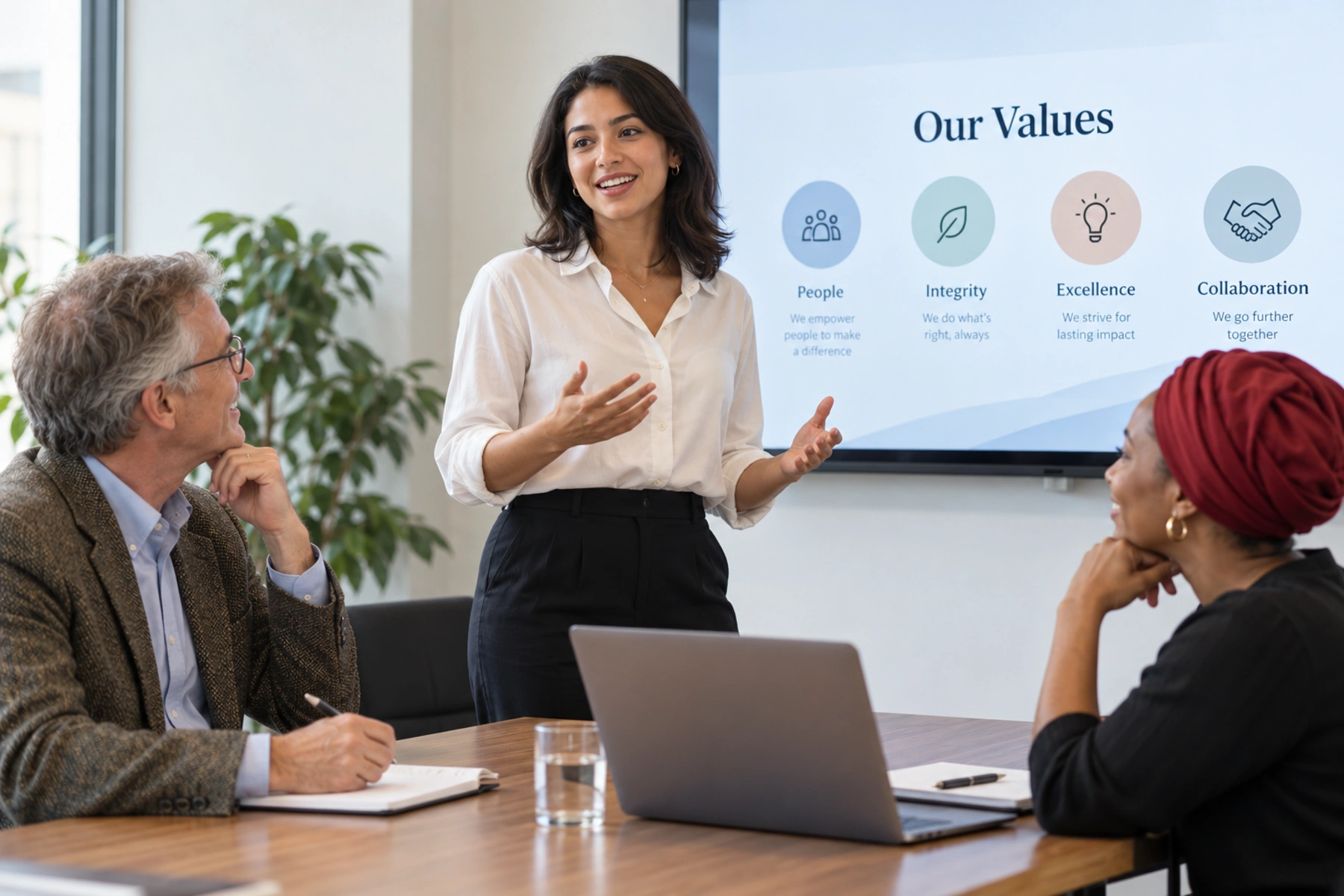
Corporate leadership training
Leadership in Sustainable Business Training Course in Libya
Prepare leaders to treat sustainability as strategy: understand environmental and social risks, improve resource efficiency, manage the supply chain responsibly, innovate for growth and govern with transparency and accountability, through practical, hands-on training.
- In-person, virtual
or blended - Customised for
your organisation - Delivered worldwide,
including Libya - For owners, executives
and entrepreneurs
Course overview
What Is Leadership in Sustainable Business?
Leading a sustainable business means aligning profit with purpose, so that environmental, social and governance considerations shape how an organisation competes and grows. The course covers sustainability principles, impact assessment, resource efficiency and waste management, responsible procurement, environmental and social risk, innovative business models, stakeholder collaboration, regulation and ethics.
Engaging discussions, case studies and hands-on exercises let participants assess risks, set KPIs and rethink an operation, using situations close to those leaders in Libya handle.
Executives, business owners, sustainability managers, environmental advocates, policymakers and aspiring leaders in Libya learn to bring environmental, social and governance considerations into everyday business, aligning profit with responsibility while protecting the long-term viability of their organisations.
Why it matters
Why Sustainable Business Matters in Libya
In Libya, economic development meets environmental preservation and social responsibility. As consumer preferences and regulation shift, leaders who treat sustainability as strategy keep their organisations resilient and relevant.
Resources are finite
Using energy, water and materials efficiently protects margins as well as the environment.
The climate is changing
A deepening climate crisis brings new risks to operations and supply.
Stakeholders are watching
Consumers, regulators and partners expect businesses to act responsibly.
Shared prosperity
Responsible enterprise helps economic development in Libya benefit more people.

The Knowles leadership approach
From Insight to Impact
The six steps trace how an organisation embeds ESG thinking, from understanding its effects to disclosing performance openly, and each one is tested for its commercial sense as much as its principle.
Sustainable business in action
- 1. ImpactWhat do we affect?
- 2. PrioritiesWhat matters most?
- 3. InnovateHow can we do it better?
- 4. EngageWho must we work with?
- 5. MeasureAre we improving?
- 6. ReportAre we open about it?
Key benefits
Why Organisations Choose This Course
This programme helps your leaders and your organisation to:
Lower Running Costs
Better resource management trims energy, water and material bills.
Reduced Business Risk
Identify environmental and social risks early and mitigate them.
Stronger Reputation
Raise brand value with customers, partners and talent.
Resilient Supply
Sustainable procurement makes the supply chain sturdier.
New Opportunities
Spot emerging trends that open new markets.
Trusted Governance
Transparency and accountability run through every decision.
Have questions about this course?
Our team is happy to help. Send us a message and we will get back to you within one business day.

Course curriculum
A practical and structured learning journey.
Twelve units in three stages lead from the principles of sustainability, through efficient, low-waste operations, to the strategy, partnerships and governance that make an ESG commitment last.
- Unit 1
Triple Bottom Line
- Assess decisions by their economic, social and environmental outcomes together.
- Analyse how chasing short-term returns can erode long-term viability.
- Show why sustainability drives business success.
- Unit 2
Development Goals
- Link the global sustainability goals to your organisation’s work.
- Determine which targets your operations affect.
- Build sustainability aims into corporate plans.
- Unit 3
Impact Assessment
- Identify what daily operations do to people and the environment.
- Examine impacts at every link, from supplier to consumer.
- Use data analytics to see which impacts are largest.
- Unit 4
Material Issues
- Rank issues by their weight for stakeholders and for business success.
- Direct resources towards the issues that matter most.
- Develop KPIs that track sustainability progress.
- Unit 5
Cleaner Energy
- Pinpoint where energy is consumed and lost.
- Evaluate renewable energy initiatives, solar among them.
- Build a financial case for energy projects.
- Unit 6
Waste Reduction
- Design processes that generate less waste in the first place.
- Explore technologies that turn waste into resources.
- Involve employees in reducing waste every day.
- Unit 7
Ethical Sourcing
- Set sustainability standards suppliers must meet.
- Manage supplier relationships and check adherence.
- Support local suppliers when communities benefit.
- Unit 8
Climate Resilience
- Assess how climate change and resource scarcity threaten operations.
- Prepare responses to water, energy and supply shocks.
- Make sites, products and suppliers more robust.
- Unit 9
Green Ventures
- Identify emerging trends that create green opportunities.
- Develop business models where sustainability drives profit.
- Pilot creative solutions before investing heavily.
- Unit 10
Stakeholder Dialogue
- Engage employees, customers and communities in sustainability.
- Create platforms where stakeholders can raise ideas and concerns.
- Work with partners to solve shared challenges.
- Unit 11
Good Governance
- Ensure transparency and accountability in decision-making.
- Keep bribery and conflicts of interest out of business.
- Have the board oversee ESG risks and compliance.
- Unit 12
Honest Reporting
- Follow progress through a few well-chosen KPIs.
- Disclose results openly, setbacks included.
- Make sure green claims meet legal and factual tests.
Course agenda
Two-day course agenda.
A sample agenda showing how the two days run, from 9 a.m. to 5 p.m. The final agenda is agreed with you.
Welcome, objectives and introductions
The triple bottom line
Morning break
Development goals
Lunch
Impact assessment
Material issues
Afternoon break
Cleaner energy
Day one reflection
Close
Recap and goals for the day
Waste reduction
Morning break
Ethical sourcing
Lunch
Climate resilience
Green ventures and business models
Afternoon break
Stakeholder dialogue and good governance
Honest reporting and action planning
Close
Participant resources
What participants receive.
A practical set of resources to support learning during the course and application afterwards.
Course Workbook
Content, summaries and activities for every unit.
Templates and Worksheets
Ready-to-use tools to apply learning at work.
Action Plan Template
Turn learning into clear next steps.
Job Aids and Quick Guides
Key models, checklists and frameworks for daily use.
Digital Resources
Additional materials to revisit after the course.
Certificate of Completion
Recognition of the training completed.

Practical application
From theory to real workplace impact.
Through case studies and hands-on exercises, participants assess an operation’s impacts, inspect a process for waste, rework a business model and take part in a stakeholder meeting, reflecting decisions leaders in Libya take as they bring ESG into practice.
Impact Mapping
Chart the effects of a company’s activities across its supply chain.
Waste Walk
Inspect each step of an operation and log where resources are wasted.
Model Redesign
Rework a business model so that sustainability drives profit.
Stakeholder Forum
Argue for an assigned interest group, then agree a joint plan.
Who should attend
Designed for leaders building responsible businesses.
It suits executives and business owners embedding sustainability in strategy, sustainability managers and environmental advocates driving change, policymakers shaping the rules, and aspiring leaders and entrepreneurs building future-focused enterprises.
- Business OwnersBuild ESG thinking into the way the firm operates.
- EntrepreneursBuild future-focused enterprises from day one.
- ExecutivesSteer the organisation by ESG priorities.
- Public OfficialsDesign regulation that rewards responsible practice.
- Development StaffHelp businesses grow without harming communities.
- ResearchersApply evidence to real business challenges.
Course format and delivery
Flexible options to suit your organisation.
Choose the format and duration that fit your schedule and learning needs, whether at your workplace in Libya, online or a mix of both.
In-Person Training
Delivered at your organisation in Libya or at a suitable venue.
Virtual Training
Interactive, engaging live online delivery.
Blended Learning
A combination of in-person and virtual sessions.
Customised Training
Tailor case studies, organisation focus, delivery mode, modules and duration. Explore Customized Training
- Typical Duration2 Full Days9 a.m. to 5 p.m. Also available as a 1-day, half-day, 90-minute or 60-minute session.
Prerequisites
Prerequisites and experience level.
No prior experience is required. The course suits people new to sustainability and experienced business leaders alike and works well for mixed groups.
No formal prerequisites
Open to anyone who wants to build a more sustainable business.
All experience levels
From students and researchers to senior executives.
Designed for mixed groups
Business, public and development staff learn together.
Ready to take part
Bring a product, site or process you want to improve.

Course framework
A structured approach to developing leaders.
The framework moves participants from grasping a principle to testing it in a case, reviewing the results and applying the lesson to their organisation’s ESG commitments.
Practical and Actionable
KPIs, assessments and checklists to use from day one.
Relevant to Libya
Focused on the development and environmental questions facing organisations in Libya.
Balanced Thinking
Profit and purpose treated as partners, not rivals.
The sustainable business cycle
- 1. LearnCore leadership principles
- 2. ExploreCase studies and discussion
- 3. PractiseRole-plays and simulations
- 4. ReflectSelf-assessment and journaling
- 5. ApplyReal-world projects
- 6. GrowMentoring and peer support
Key learning outcomes
From knowledge to lasting leadership impact.
By the end of this programme, participants will be able to:
- 01
Assess your impact
Analyse the environmental and social effects of an operation.
- 02
Set clear priorities
Rank sustainability issues and set KPIs for those at the top.
- 03
Use resources well
Improve how efficiently energy, water and materials are used.
- 04
Source responsibly
Ask suppliers to meet clear, fair standards.
- 05
Engage stakeholders
Involve employees, customers and communities through open dialogue.
- 06
Report honestly
Report on ESG performance accurately, without overstatement.

Profit and purpose need not compete; the strongest businesses pursue both.

Example exercises and tools
Learn by doing.
Hands-on tools and assessments are applied to the operations, supply chains and strategies participants manage.
Case studies and hands-on exercises reflect decisions leaders in Libya may meet: weighing a renewable energy initiative, setting standards for suppliers in an ethical supply chain, or choosing the KPIs that will show a board whether a waste reduction plan is working. Participants test their options against ESG considerations and legal requirements, then plan how to bring employees and customers with them.
Materiality Matrix
Chart issues by their importance to stakeholders and to long-term success.
Energy Audit
Identify the biggest energy users and losses at a site.
Supplier Checklist
Set out the criteria suppliers must meet and how to check them.
Greenwash Test
Examine whether green claims rest on evidence.
Assessment
Assessment and learning progress.
A mix of steps before, during and after the programme keeps learning relevant and turns it into action.
Before the training
Share your goals and team context.
Agree the objectives and focus areas.
Confirm the format, timing and group.
During the training
Role-plays, simulations and practical exercises.
Feedback from experienced leaders as skills develop.
Group discussion and reflection.
After the training
A personal action plan for the workplace.
Self-assessment and guided journaling to track progress.
Ongoing learning through peers, mentors and the alumni network.
Workplace application
Relevant to your context.
Participants use the tools in companies and public bodies in Libya, from reducing one site’s energy use to setting ESG goals for an entire organisation.
- Energy ManagementLower consumption and energy bills.
- Waste ProgrammesGenerate less waste and reuse more.
- Supplier SelectionPartner with suppliers who meet standards.
- Product DesignMake products more efficient to run.
- Community ProjectsWork with communities on shared goals.
- Board ReportingGive the board clear ESG updates.

Let’s discuss your requirements
Request a Customised Leadership Programme.
Talk to our team about how this course can be tailored for your organisation in Libya or other locations worldwide.
- Share your priorities
- Receive a tailored proposal
- Explore delivery options
Adapting for Libya
Adapting the programme for Libyan organisations.
We tailor the course so it reflects your people, your sector and the context you work in.
Local case studies
Examples and case studies drawn from leaders in Libya.
Cultural awareness
Content that respects cultural nuances and builds inclusive environments.
Community focus
Projects that address real local and community issues.
Industry and organisation focus
Examples, terminology and scenarios from your sector.

Delivery worldwide
Flexible delivery across Libya and worldwide.
We deliver this programme in Libya and in other locations worldwide, with flexible formats and options to suit your organisation.
- In-person
- Virtual
- Blended
At Your Workplace
In-house sessions at your office in Libya.
A Venue You Choose
Delivered at a training venue that suits your team.
Live Online
Interactive virtual sessions wherever your people are.
Across Countries
Programmes coordinated across several locations worldwide.
Client experiences
What our participants say.
Word-for-word feedback from participants at organisations in Singapore. Read all reviews
Yes, the strategic frameworks shared are highly practical and worth learning for career growth.
Yes, because it really highlights how our daily business decisions directly impact the local community and the environment.
Yes, the communication strategies are practical enough to be used immediately in our everyday project work.
The course allowed me to identify the area where errors could occur and the various steps to identify and reduce the errors. Case studies were also provided to give a real-life experience instead of theoretical lessons.
Yes, I definitely would. The program teaches you exactly how to approach closing deals and handle tough discussions with confidence.
Yes, because it serves as a helpful reminder to prioritize mental well-being alongside daily targets.
Frequently asked questions
Common questions about this course.
What is the main focus of this course?
Making sustainability a strategic priority: understanding environmental and social impact, focusing on key issues, using resources efficiently, managing supply chains responsibly and engaging stakeholders transparently, applied in Libya.
What topics does the course cover?
Twelve units in three stages: understanding impact (triple bottom line, development goals, impact assessment, material issues), greener operations (cleaner energy, waste reduction, ethical sourcing, climate resilience) and strategy and trust (green ventures, stakeholder dialogue, good governance and honest reporting).
Who should attend this course?
Executives, business owners, sustainability managers, environmental advocates, policymakers, entrepreneurs and aspiring leaders who want to align profit with responsibility.
Is the course suitable for new or first-time leaders?
Yes. Aspiring leaders gain a firm grasp of sustainability principles, and seasoned executives learn to make ESG part of strategy.
Is the course practical or theory-based?
Largely practical. Engaging discussions, case studies and exercises have participants chart impacts, inspect processes for waste, rework business models and engage stakeholders.
How long is the course?
The standard course runs over 2 full days, from 9 a.m. to 5 p.m. It can also be delivered as a 1-day, half-day, 90-minute or 60-minute session.
Can the course be customised for our organisation?
Yes. We can adapt the content, examples and format to your goals, industry and team. See Customized Corporate Training for how we tailor programmes.
Can we use examples from our own industry?
Yes. We design and deliver our courses with subject matter experts in each field. Tell us about your industry, context and terminology when you enquire, and it will be taken into account.
Can we combine this course with other topics?
Yes. We can combine related topics into one programme or build a learning pathway across several sessions and levels.
Is this course available outside Libya?
Yes. We deliver this programme in other countries worldwide, in person or live online, and can coordinate it across several locations.
What delivery options are available?
In person at your workplace or a venue you choose, live online, or a blend of both.
What kind of exercises and activities are included?
Impact charting, a waste inspection, a business model rework, a stakeholder meeting, an issue chart, an energy review, supplier criteria and a green claims check, with feedback.
Do participants receive mentoring during the course?
Yes. Participants receive mentorship and constructive feedback from experienced leaders throughout the course.
Will participants build a professional network?
Yes. Participants connect with fellow participants, build mentoring relationships with facilitators and guest speakers, and can join an alumni network for ongoing learning.
How does the course support personal growth?
Through regular self-assessment and reflection, guided journaling to track progress and set goals, and techniques for mindfulness and stress management.
Is the course relevant to the Libyan context?
Yes. It is designed for organisations in Libya, with case studies on renewable energy, waste reduction, ethical supply chains and the ESG questions local businesses face.
Which cities in Libya can the course be delivered in?
We can deliver it in cities across Libya, including Tripoli, Benghazi, Misrata, Tarhuna, Sabha, Zawiya and Ajdabiya, and other cities on request. We also offer a full range of leadership courses in Libya.
Can we download a course brochure?
Yes. Download our course brochure for an overview of our training programmes.
How do we request a proposal?
Share your goals and requirements through the enquiry form on this page. Our team replies within one business day with suggestions and a tailored proposal.
Who can we contact about this course?
Email [email protected], call +65 6714 6663 or use the enquiry form on this page. We reply within one business day.

Next steps
From enquiry to delivery.
A simple, transparent process from your first message to the training day.
- 1
Enquiry
Share your training needs and priorities.
- 2
Consultation
We discuss and refine the scope with you.
- 3
Proposal
Receive a tailored proposal with delivery options.
- 4
Confirm
Review, adjust and agree the details.
- 5
Delivery
We deliver the programme for your team.